Showing posts with label article. Show all posts

2022 in review: IoT, ray tracing and web

Another year has come to pass, and it’s time for some more reflection! Despite its many flaws, the (only? :s) one way this year has been a successful one is through all the code I’ve managed to write. So without delving more into all the melancholy, let’s jump right in on what really matters in life and think of all the great projects I’ve had:

I started the year with embedded development in C#, then did two intensive months of game development - starting by learning Vulkan and ray tracing from scratch, learned Kubernetes and Terraform, a bit of cloud, worked on my homepage, and then did a bit more of embedded stuff by writing some programs to monitor and control factories in Minecraft.

Embedded .NET with Meadow

For the first half of the year I got back to embedded development and managed to drastically improve the UX and reliability of setting short timers. This is all thanks to the Meadow platform having reached a much better maturity compared to how it was the year or two before, when I first started working on it. I even wrote a post about the adventures I had when designing and implementing that system. There’s also a short Youtube clip illustrating how it’s all used in my daily life. At that point I was feeling really good having “shipped” something useful, and moved on to the next topic. Before this (for many many years) I had used the same launcher, but the countdowns were opened to a browser window.

Plus, over time I’ve gotten really used to the system, and thought that I couldn’t ever live without it. This assumption was however challenged a month or two ago, when I upgraded the firmware on the device running the display hardware, instead of the other device I was supposed to develop serial port things on. But what the hell. Let’s just upgrade it to the new OS and get all the promised stability and performance upgrades while at it. Maybe those would even eliminate the very rare restarts when a watchdog timer set by me times out.

One of the big new features of that new release was the inclusion of a new linker, which is able to trim out unused code, greatly reducing both the code size and the startup speed. Unfortunately, this specific linker isn’t implemented the same way as the one by Microsoft in the full .NET SDK, and there seems to be no working developer-facing options to alter its behaviour yet - it's all beta. The way it’s currently implemented strips out code needed by reflection-based serialization, leaving me stranded with my API calls.

One could think that I could always go back to the old OS, but the matter has two obstacles. The first being the tooling, as it is still under active development, and there’s no apparent way to install a previous version. Though I highly doubt it’s been blocked yet, and there’s a responsive Slack channel to ask about these things. But the second one is quite embarrassing. The last time I worked on the codebase, it was when I moved the server side stuff to my Kubernetes server (more on that later), and it turned out to be a more involved operation than originally foreseen.

When I finally got it to work, I was rather frustrated, and seemed to have forgotten to make the final commit - but there’s really no excuse for this kind of irresponsible behaviour. So after I had done the OS update and the code updates to go with it, I no longer had a working version to go back to. Rather than taking the time to fix things, I’ll just have to live with my mistakes until the new OS is at a serviceable state. At least I’ve had plenty of things to keep me busy and not thinking about it. Quite the theme overall…

Vulkan and ray tracing

The timing for my next expedition couldn’t have been better. After I had neatly finished the work on the timer (but before the OS update), there was a bit of time to relax. How unheard of. When it was time for my summer holiday, I was already anxious to try something new. For a long time I’d been meaning to learn Vulkan, and now I also had the spirit and the time for it. And not just Vulkan, if things would progress well.

I think it took me about a week to go through most of the tutorial. I had originally anticipated it to take the whole month, so my spirit was further elevated by that triumph! As detailed in the relevant post, one of my long-lived dreams has been to build a game with realtime soft shadows. I’ve always thought the math for it to be beyond my abilities - except now. Armed with Vulkan and powerful hardware, perhaps I could just brute force my way to it.

And it all started rather promisingly. I learned more than I could have hoped for, and even got good results on the screen, at interactive frame rates.But the quality fell short of what I’d hoped for. And with that, so fell my motivation to work on it. Despite this, I still managed to achieve some rather great things after the initial blog post, namely multiple importance sampling (MIS) and the integration of Nvidia Realtime Denoisers (NRD). Both improving the quality and performance by at least an order of magnitude or two. Almost enough. Almost.

It sucks that I haven’t documented my journey better than I did, as this is the most impressive thing I’ve achieved in a long time. There’s some nice screenshots on my Twitter page, and some short compression-butchered video segments on my Youtube page, but that’s it.

But the reality of it is that the intensive ~two months I worked on the project really burned me out for a long while, despite all the impressive things I achieved. I really enjoyed what I did, but everything has its limits. Though truth be told, RT is perhaps something that I don’t really wish to pursue more. It was very rewarding, but as a concept it’s not really something that interests me that much - I was really only after the results. I thought that simple 2D shadows would be easy to implement with the new technology, but the truth is that they are actually even more complex than 3D ones, at least when implemented the way I approached them. Sunken costs kept me engaged.

But when it comes to using Vulkan as a graphics API, I really did enjoy it a lot. It’s so much nicer than OpenGL, as it’s without all the technical debt of immediate mode rendering and old hardware pipelines, while explicitly supporting all the new things that make development easier and the code more performant, such as pre-compiled shaders and cached pipelines, and multithreaded API design. Though it’s still not easy to use it optimally by any means - especially when it comes to supporting heterogeneous hardware. I already liked OpenGL, and I like Vulkan even more.

A few years back I made yet another version of my unicorn game project - codenamed Unnamed Spacefaring Game: Energized (with modern OpenGL and C#) - and I thought that the code I wrote for it was diamond-grade. Not quite. Or maybe it was, compared to how the previous iterations were implemented on top of a decade+ old Python codebase. I also had big plans for writing the engine side in such a way that it would be able to run efficiently on many-core systems. This wasn’t easy, and it was further complicated by the APIs offered by OpenGL. The solution I arrived on was ambitious, and I feel really bad I never got far enough to really test it in battle.

Vulkan on the other hand has native support for many frames-in-flight and multiple descriptor sets. These features could be used to drastically simplify the resulting architecture, perhaps even completely eliminating the need for all those ambitious inventions I had. I’m very conflicted on how to proceed. Everything sounds almost too simple. Though I guess there’s still some demand for building infrastructure for better multithreading, but the big picture has warped so much that the old plans don’t apply anymore, and I’d have to spend more time planning against that new future to be able to say anything conclusive.

But what I do know is that the code I wrote for that RT Unnamed Building Game was a lot better than that of USGE. I’m really hoping to get back to UBG someday, as its scope is also a lot smaller than USGE’s; if I’d be able to keep the idea alive, yet yeet the RT things, it would be something that could realistically be shipped, and perhaps sold. Though, without RT most of the novelty and graphical appeal wears off…

I guess it’s all about managing scope; it would also be possible to ship a version of USGE with only a few months of development. It would be a technology demo, but a fully playable game nonetheless. But there’s been enough gamedev for now.

Homelab and custom auth

As told above, I had used up (almost every waking moment, I might add) of my summer holiday for learning Vulkan and RT, and there was still a lot to do. Meanwhile at work the then-current project had evaporated over the holiday, and for a moment I was left without one. This gave me the energy to continue learning, but still I faced that eventual burnout. This “opportunity” meant that I could pivot my focus at both work and at my own time to learning about Kubernetes, and forget about all the unconqueable things in ray tracing.

Plus, yet another of my long-time dreams had been to have a solid infrastructure for running self-hosted software - both of my own making, and by other people. And doing it securely. So I didn’t really mind the literal double-timing of learning new things so soon again.

And a lot of new things I learned. It took a bit of iteration, but now I have a somewhat satisfactory hierarchy of Kubernetes manifests, and a small-yet-equally-satisfactory collection of services described by those manifests. All hosted on an ebay’d tinyminimicro-sized server I bought just for this purpose. The server's awesome: it's tiny, x64, and consumes about 6 watts at idle. Pity it has only 8 GB of RAM, and doesn't have the PCI-E connector for a 10+ Gbit network card soldered in. Also, I’d still like to do the manifests over one more time - this time using Terraform for avoiding some repetition on specific parts of the infrastructure. A bit more on that in the next section.

I had hoped to create a VLOG episode about all things homelab, but that didn’t happen this year. But what I instead have is a two-part special about one facet of it - namely authentication and authorization. I’ve materialized a lot of my dreams this year, and the theme continues :)

I set up a monitoring stack with Postgres, Grafana and Prometheus, and migrated some of my own server applications to the new hardware (countdowns, hometab, …). I also set up an instance of changedetection.io. All of these things benefit from unified access control in the form of single sign-on (SSO). As illustrated in the first part of the VLOG, I had initially set up Authelia for this task, but it was not to my satisfaction.

Moonforge

So I did what I do best, and made my own. While this is a bold move even by my standards, I kept things realistic by having Keycloak do the actual user authentication, and having my service continue from that. It’s called Moonforge. All it does is minting and validating JWTs based on configurable policy. There’s more information about this in the second part of the VLOG.

But in short, Authelia felt really nasty because it had a single login cookie for everything. With Moonforge, the user logs in to Keycloak, and then to Moonforge via OIDC, and afterwards to the actual applications with OIDC-like semantics, even if the applications don’t natively support it, thanks to special reverse proxying routes spanning some paths even in each application’s own domain. The JWT cookies for these logins are application-specific, and can’t be used to access other applications unless the user specifically allows it on a case-by-case basis.

I really think that having my own service for auth is for the best - as long as I haven't made a mistake in something elementary. As further detailed in the VLOG, the alternatives are just not that appealing. Authelia requires me to fully trust the applications it protects, and standalone Keycloak is too complex to configure: I’m bound to make a mistake. If I build my own, I know for sure how to configure it. And since I’ve been doing backend stuff for a long time, I hope for everyone’s sake that I’ve learned to build a simple one that is reasonably secure. After all, the harder parts are still done by Keycloak - for now. And I’ve already spent enough time looking for ready-made solutions.

Besides, having an auth(n|z) solution of my own has been yet another long-time aspiration. I think I did some initial UI planning as far back as 2015, and it took until now to implement a system. It looks nothing like originally envisioned, but that is partly due to how the focus so far has been on authz instead of authn. Plus, I haven’t really decided whether I want to let it have its own visual identity, or whether to have a more standardized appearance around my core css.

While the visual identity is a definite nice-to-have, the actual technology behind the scenes is what it’s really all about. In its current form it replaces Authelia with something more secure, without offering much more than that. The foundation I’ve built everything on feels really solid and well grounded. The cookie paths and domain are sensible, and there’s been effort in building everything with a focus on security. There’s extra care in JWT validation, and things like embedded keys and alternative signature algorithms have been explicitly disabled - strange how some JWT libraries don’t even have the option to disable these features. And the small scope has definitely helped.

As I’ve mentioned many times now, for a project of this scope, having Keycloak be part of it is sensible. But I’m hoping to find the time to replace it with my own implementation. When I was still working on Tracker, I implemented a login flow similar to how for example WhatsApp Web works now. That type of passwordless flow was really nice, and I’ve wanted to replicate it in a more generic setting, while also adding some other security features. Hence the dream. In the VLOG I talk about all the things I’d like to add and how they’d strengthen the security of all the services relying on the system - pushing more and more of the auth functionality on to better trusted companion devices, outside the device and the server the login is being performed on. There's also plans to harden the surface which mints the JWTs by requiring input from a trusted device. I’d also like to get hands-on experience interfacing with security keys such as Yubikeys.

Moonforge is far from being feature-complete, but it’s perfectly serviceable for its current task. I feel good, and with that 'final part of the 1st stage' of my Kubernetes infrastructure implemented, I now have what I wanted: a stable foundation for hosting and building self-hosted services and applications. Next up is Terraform, better uptime monitoring, perhaps distributed logging and most importantly improved machine-to-machine authentication. And maybe even making more VLOGs on the topic.

Terraform, cloud and static HTML generation

With the things at home looking so good now, why stop there? The next thing I could be improving is my (still perfectly functioning) decade+ old homepage. The current site is hosted on a single server, and the PHP in it dynamically serves WikiCreole-based content. I’ve been meaning to replace it for the past two years with static generation and geo-replicated hosting, but the time hasn’t been ripe. Except now*.

There’s been demand at work to learn more about the cloud, and I was able to use this to my advantage. I was required to set up a static website on AWS S3 and CloudFront, so why not use what I learned for the new site? And while at it, why not do it properly. This is again a topic that would have made a great VLOG episode or a post of its own, but I’ll try to be brief.

At work I was given Terraform to accomplish the task, and I quickly fell in love with it. It allows for writing all the infrastructure as “code”, a bit similiar to how Kubernetes manifests work; precise and to some degree self-documenting. And making changes is easy, as the user doesn’t have to know the exact commands, they only need to tell how they want the end result to look like. It’s a really nice way to work.

The best advanced feature of Terraform are the “modules”, which allow for defining complex reusable components, which in turn expand to a set of simpler pieces of infrastructure. While that’s an overkill for just a single static website, I’m looking forward to migrating all(?) my Kubernetes manifests to Terraform. While raw manifests are mostly fine, the biggest pain point for me has been in defining firewall rules and HTTP(S) ingresses. These are very verbose, and contain a lot of dupliction between each other. With Terraform I should be able to write a single custom utu_http_ingress module, which defines all those at once. There’s also some special additions that need to be done to each Traefik (the reverse proxy) HTTP ingress route entry in order to support the special login paths needed by Moonforge - having the module transparently do this in a centrally defined location is awesome.

With the basic infra up, the more fun part was uploading the content. I could have used some type of shell script and aws-cli to upload the site content, but it turned out to be really easy to use the SDK and build my own program. With it I could easily incorporate some extra steps, such as only uploading the files that have been changed / renamed between each run, and more importantly transforming the uploaded filenames and paths. The static site generator includes the .html file extension on all content, and I was trivially able to remove that. There was also some special logic on how “index” pages and paths worked with the PHP site, and I was able to take that into account, too.

And lastly, I learned that CloudFront is able to compress the content it serves, but this feature depends on the file types and the available CPU time on each edge server. The only way I can ensure that the content is always served compressed is to save it pre-compressed to S3, and then return Content-Encoding header with the correct value for each request. But now that I control the upload process, this was no problem :)

And speaking of content, that’s a topic for another post, again. A few years back I stumbled on statiq, and found it to be the least-sucking tool in the .NET world, so that’s what I chose and started to slowly port over the site itself, and the content. Instead of WikiCreole and PHP I had Markdown and C# HTML compiled down to plain HTML.

With this new technology stack I could also accomplish some of my long-time desires for ever so slightly improving content-discoverability on the site. Along with the old stuff, the site also serves as the companion for my VLOG, containing the scripts, some technical specs and other commentary on each episode. I wanted to make it easier to move between different episodes and projects, so I implemented a sidebar navigator for this.
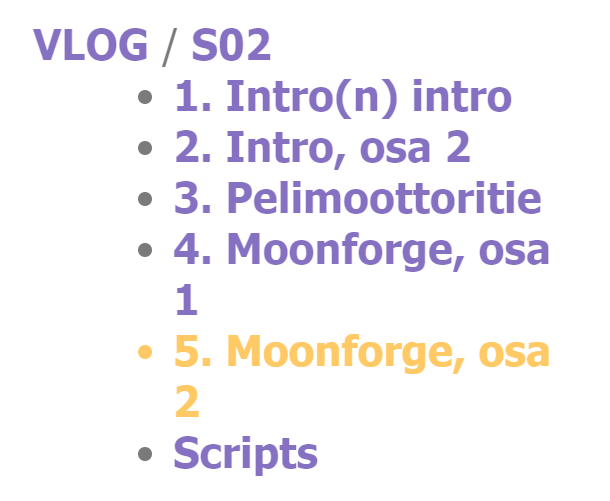

Site generation in statiq is a multi-stage process, with one of the stages being content discovery and “front-matter” parsing. This way each page knows what other pages exist, and I’m able to pull similar pages from the metadata to the sidebar - either by the folder structure, or by a special grouping key. This metadata is also used to build navigation breadcrumbs.

*The tool still sucks, though. It tries so hard, but fails. There’s a live-reload server for avoiding full rebuilds when working on individual pages and templates, and a caching system so that those full rebuilds can be avoided also when publishing. Unfortunately, both have been broken for several years. The live reload server needs to be restarted whenever a page containing an error is opened (so don’t save a live-reload page until the code compiles!), and the caching system doesn’t purge the metadata cache, so pages appear multiple times in it, breaking the sidebar.

I was going to sidestep all that by making a hot-reload system of my own, by building on the “hot” reload technology I invented for USGE and UBG and UBG's asset pipeline. Newer dotnet supports unloadable assemblies once again, so it’s possible to keep the compiler and dependencies loaded in memory, but still dynamically reload all the user code - a sub-second operation. That way I could delete the cache between rounds, and avoid the server dying whenever an error occurs, by simply very quickly restarting it after each run instead. Unfortunately statiq always starts a text-based debug console meant for live-reload even when not using it, and never cleans it when exiting, thereby failing to run again in the same process. The relatively complex code which does some high-level orchestration of the generator is rather tightly coupled with the code controlling the debug console, so it’s not an easy task to separate these two. Even cleaning up afterwards is not trivial. FML.

Despite this, the preview for the new site is live, and the DX is a bit better than before. And it’ll get better, won’t it? And if not, I’ll just have to make my own generator. There’s still work to be done in upgrading imagepaste, perhaps the contact form, and transferring over some other static content. I’d also like to improve the page load latency, so I’ll have to find a way to cache the CSS file, yet reliably invalidate it without rebuilding the whole static site. That might be impossible to do without scripting. But for now, at least the primary content has been migrated succesfully.

Minecraft and Lua

It’s been a tight year, and I wanted to take my mind off other things, so I found myself gravitating towards modded Minecraft once again. Plus, it’s just so damn addictive it’s hard to keep away for too long.

This time I’ve been playing Create: Above and Beyond, a non-expert modpack with strong progression. The focus is on Create, a “low-tech” automation mod, which has large moving machinery which in my opinion fits the theme of Mincraft really well. As the technology level keeps increasing over the playthrough, some products benefit from automating them with programmable in-game computers. It’s also fun to monitor some production chains, such as the amount of charcoal fuel.
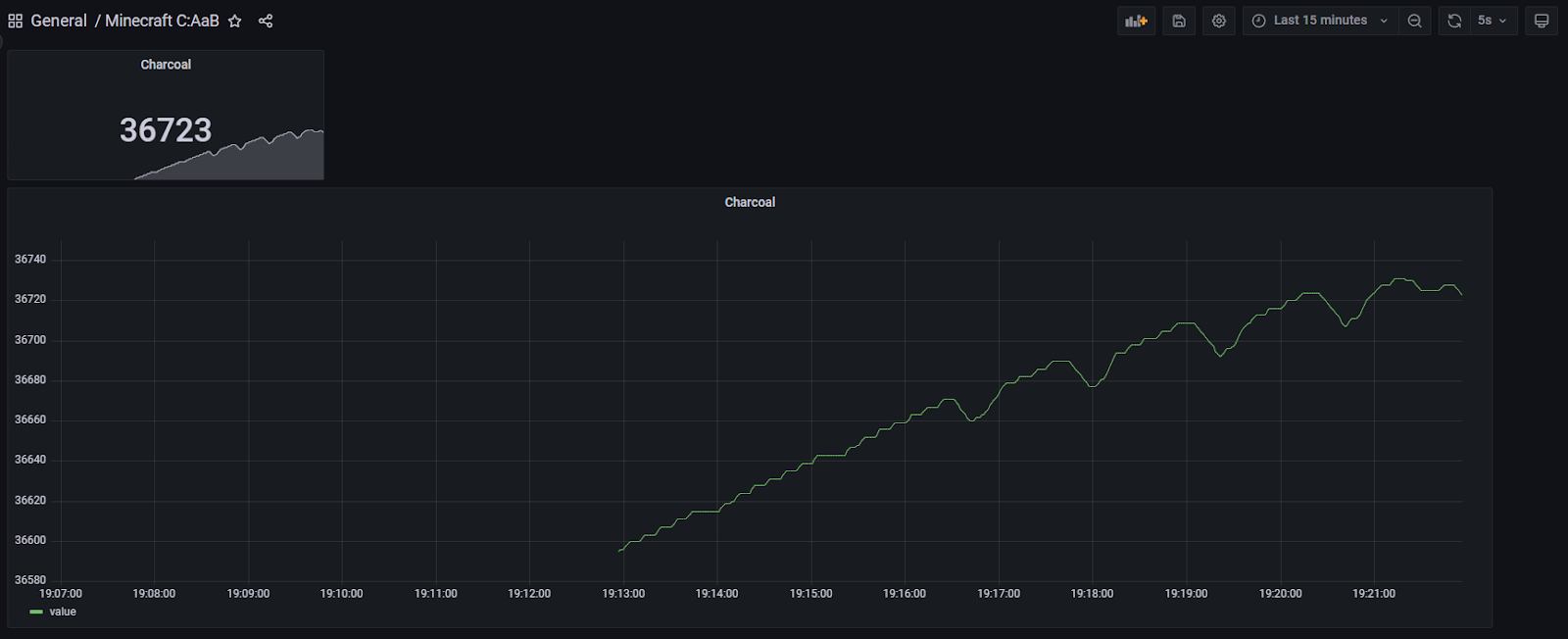

Few years ago I already built some libraries for saving metrics to Postgres (with plans to migrate to TimescaleDB), so this time I was able to build an in-game Lua program, a metrics gateway server and a Grafana dashboard in two short hours :) This was a good primer for the more complex factory-controlling programs.

While the modpack is heavily focused on doing things with just Create, some things would get needlessly complicated when done with just in-world redstone circuits. Just like I really enjoyed describing infrastructure with Terraform, I also enjoyed avoiding complex circuits with Lua code. It’s a lot more self-documenting, and the code itself is creeper-proof :p Some might argue that the beauty of the game is using those simpler primitives for achieving the end goal, but at some point it just becomes plain frustrating. Though in this case I’m not very good with Lua, and I’m not even trying to be: I know the bare minimum, and use that to make the programs. I guess that’s my way of playing the same game.

And as it was beautifully noted to me, I guess I’m in the right industry when even relaxing and playing video games leads me back to writing code. Or alternatively, I’m just a sick and troubled mind, which can’t ever truly let go and just relax (:

Closing words

Whoa. It seems I’ve been really active this year. Maybe too much so. But, for now my only real regret is that I haven’t documented my doings even better. This post ended up a lot longer than I first anticipated trying to cover even the majority of what I’ve done. Especially the gamedev things. But at least I have something to show for it, and I did at least try with Twitter.

Thanks for reading! If you are - for some strange reason - after for even more to read, can I recommend you the 15 year anniversary post of the blog. It’s a lot shorter, I promise!

PS. I’m also working on a little something to highlight all the wonderful private code commits of mine, and also my other online doings in a central place. Stay tuned.

Adventures in making a .NET IoT timer with Meadow

Despite the hardships I described in the previous post I’ve managed to produce something. Something rather cool! While I’d like to present it in video form, I’m just not feeling up for it. Blog texts are more my medium, anyway. Or maybe it’s that I have more than ten years of experience with this; can’t say the same about video :d

Anyway. A brief summary before embarking on this adventure: I made an internet connected timer display! On a microcontroller! With little previous experience. With .NET! Started with a dirty “MVP”, and then focused on improving the stability until I was satisfied. Next step would be to add more features on this rather solid foundation and improve the form-factor. See a short clip about it! There's also a clip about an early version.

This is a relatively small project, but I have a lot to tell! Writing this all must have taken at least a dozen hours or so. Maybe even more :o

Background

To prepare for this adventure, let’s first take a step back and start from the beginning with some background, as usual. Feel free to skip to the next section at your leisure, or even the one following it.

Eons ago I implemented a JavaScript-based countdown timer. It started as a pizza timer and initially saw most use at small LAN parties, and due to the convenience I’ve also used it for other foods too :p But it could have been even more convenient! So, I added a shortcut for it to my Runner, which is a Win-R replacement with strong customization. After this I could launch it just by pressing Win-Q and typing cd 12, and this would open the timer page in browser and set it to count down from 12 minutes with the query string. How easy is that!

But sometimes there’s a need to also count to a specific point in time. So, I added a command for it. at 12:10 would open the timer, and set the remaining time in such a way that it would trigger at that given time. This opened up a lot more possibilities for use, and it often was the case that I had several timers running at once. And more than once some of those timers were set for longer times, and I happened to restart my PC during them. Let’s just say that a dumb browser-based countdown isn’t quite compatible with that concept. Not to mention the times when Chrome updates prevented the timer for accessing audio due to low user engagement. Thank god there was a group policy to fix that. It was also a bit of a bother to either keep the tab active, or constantly take a peek to see how much time there was remaining. I could have moved the timer to a second monitor, but it would have required extra effort. If I even had a second monitor, that is. A single ultrawide is more of my thing.

A plan forms

I needed something better. Something which provided that durability and reliability, with the “ergonomics” being a still-important secondary feature. And with the alarms tied to specific instants in time instead of arbitrary durations. I considered my options, and saw two clear options. Either a Windows application with automatic start and a screen overlay, or something that I could run on a smaller embedded device like the Raspberry Pi. This second option would then need some kind of API to interface with it from the desktop and extra hardware to enable sound and the display.

The second option was superior in the sense that it would function independently of the main desktop, and the platform would likely have fewer interruptions due to reboots etc. But that extra hardware was quite an issue. But in this I also saw a third option. A true embedded device. Something where I wouldn’t even have to concern myself with OS level stuff like getting my app to start automatically and staying running. And I was already in possession of suitable hardware, and now software, too.

This third option is of course the Meadow F7 device from Wilderness Labs, which I owned two (now four). Some time ago it had received an update which enabled the built-in Wi-Fi hardware allowing it to be easily connected, and I already had the other extra hardware that was required from the accompanying Founder’s edition “Hack Kit” and an Adafruit order, namely the displays and a buzzer. 

The microcontroller form-factor also offers advantages with size and (perceived) reliability, with restarts happening quicky. At least once there’s AOT… And most importantly, I wanted to do things on a microcontroller. Maybe I could event have the device battery powered some day? So that’s what I set out to build with.

And boy, did I build a fine thing in the end ^^

Concept validation

Few years back I had already played around a bit with the Meadow, and built for example a code breaking game with almost the same exact hardware, so I had a pretty good idea how to approach this particular problem. The functionality itself was rather simple, both logic- and hardware-wise. Initially.

Another goal I had was that the device itself wouldn’t have any human interface. Everything would still be driven through the Runner for superior usability, and as such the device would have to be connected to the control server either via IP or a serial connection. I already had some experience with the serial connections, but IP is always so much cooler, and also more standalone in this case.

And as a bonus, I wanted to have the ability to have alarms displayed on multiple devices at once. That way I could have one on my desk, another in kitchen etc.

So, I started by proving that the device would indeed be able to communicate over IP as advertised, and that it would also retain that ability over longer periods. I took the provided Wi-Fi sample code as my starting point and got to work.

I was quite pleased that the sample worked unchanged (not counting network configs). Could it really be this simple? Encouraged by my success, I moved on to the next phase, and quickly implemented a relatively simple .NET 6 based backend for all my timing needs, accompanied with a HTTP wrapper for making requests on the backend.

But I still had scepticism regarding the networking in Meadow. On the other hand, I’ve often struggled with trying to build things that are too perfect too soon, so this time I settled for the “bare” minimum and just rolled with it. I didn’t bother to implement persistence, opting to just store things in memory. This wasn’t a lot better than just having the things in a browser, but at least it was magnitudes better than keeping the stuff only inside Meadow’s memory. I could always add the persistence layer when the more uncertain things were less uncertain.

Unfortunately, my initial scepticism was confirmed. When I got even slightly more serious about my use of the network, the device just hung. Sometimes this happened within a minute of boot, and sometimes took more than an hour. That wasn’t great. Not great at all. But hey, the device is still in beta, and the people working on the device assured me that stability improvements were actively being worked on. And they were later fixed!

As explained, getting the thing to work wasn’t the end goal. Getting them to work reliably was. On any other week I would have probably been quite devastated when something this elementary wasn’t working as expected. But now I embraced the challenge presented. I even had a secret new tool at my disposal now. One I had been itching to apply somewhere.

Implementation

A while ago the hardware watchdog in the device was exposed for use. While not exactly graceful, it was perfectly effective in getting the device to recover. Challenge overcome. How unexpectedly anticlimactic. Additionally, a later firmware update greatly improved network stability.

Now I had more time to focus on the application domain, then. I needed two things. First, I’d obviously have to get the timers to the device. And second, a closely related mandatory reliability feature is getting the device to recover those timers on booting. Something that would happen quite often for the foreseeable future.

Luckily this was something I had anticipated with the initial architecture, and almost the sole reason the server component even exists. While I didn’t set out to build perfect right away, it had to be better than just persisting the timers in the device’s RAM. Especially this early in development I assessed that the server would have a lot less restarts than the device, and it wouldn’t make sense in trying to persist anything important on the device.

Or at least I didn’t know enough about embedded hardware to know how reliable it is. All I know is that SSDs on PCs are quite reliable. And a magnitude more reliable yet if the server is clustered over many physical computers and the writes go to multiple independent storage devices. But that’s another adventure altogether, best embarked some other year.

MVP

Let’s talk about the APIs first. Respecting the pledge I made to myself earlier, I started by building something less desirable, but what would work with minimal work. And what’s easier than polling over HTTP?

No state-keeping, no events, just a dumb endpoint that returned the next countdown timer. And as I wasn’t familiar with the characteristics of the device’s clock and its accuracy, I made the endpoint also return the current time. The device could then compute the exact current time by diffing to a stopwatch which was reset when the endpoint polled.

And there I had it! Thanks to the code breaker project, it didn’t take long to have the remaining time visible on a 7-segment display, and the end of the timer visualized by flashing a Charlieplex led matrix. A fully functional MVP already.

Ending up with a viable end result is rather unheard of, as far as my things go. As hinted, usually my projects are very long and I aim for the perfect. Sure, I’ve learned a lot doing it, but only rarely managed to produce an artifact, and of any real use. And that I had something again, it felt really good! I had really missed the feeling.

Further improvements

Now that I had a minimum viable product, I could have just ended it there. But it’s just not in my nature. I had already put a week of work into it. What if I put in another? I could do so many nice incremental improvements, and all the time have a working thing. Even if I quit, I’m left with something worthwhile. Plus, I was feeling good. I really wanted to keep working on it. Even if my fascination got a bit unhealthy towards the end of the first week. Surprised myself by taking a short break, and was again energized.

And there’s a lot I ended up improving. I’m not sure how I should best present everything, so here comes something. It doesn’t have to be perfect, right?

Networking

The first obvious improvement was how the device interfaced with the server. If you recall, the first implementation was simple HTTP polling. Polling has high latency, and this was something that needed instant feedback in order to feel reliable. If I set a timer, I want to immediately see that it got set and move on to do more important things.

I could have upgraded to long polling and call it a day, but publish/subscribe is a lot cooler. Plus, it’s more efficient and scales better, not that it was an actual concern. While I’ve tried to make NATS my go-to in this regard, I decided to go with another of my favorites: Redis. It’s a mature codebase, and the wire protocol is dead simple, so it’s going to perform extremely well for my scenario.

Except it didn’t. I tried using the de-facto StackExce.Redis package, but it turned out to have too many features. Meadow executes code in an interpreted mode with some rather primitive JIT, and all those features with a complex handshake meant that the initial connection took a long time, enough to blow past about every conceivable timeout. Even five minutes wasn’t enough to complete the whole handshake. That was just too much.

I could have tried NATS yet, but decided to play it safe and go for the nearly polar opposite. And have a chance at doing something I had been missing a long time. Pure UDP. Minimal framing. Dead-simple connectionless protocol with timers. Handcrafted packets. Oh, how I had missed that world; it has been so long since I had worked with Tracker.

And third time’s the charm. Performance was awesome and things just worked. And would they happened to not have worked, timers would soon rectify the situation. I was happy.

There are just two packet types. The device sends discovery packets at an interval to the server, and the server sends status packets at an interval to all devices which have been discovered. And if there’s a new alarm, the status packet is sent immediately, allowing the device to pick up the countdown without delay. Sure, it was excessively chatty when there were no updates, but it was also excessively simple and reliable.

The discovery packet is just a simple sequence of “magic” bytes, and that’s it. The status packet is more sophisticated. Mirroring how the HTTP polling endpoint worked, it contains a sequence of the next few upcoming countdowns which the device hasn’t yet finished. Additionally, the packet starts with a hash of the data it represents. The data doesn’t change until the old alarm passes, or a new one gets inserted before it. This means that the client can simply check those initial bytes of the packet for the hash, and stop parsing if it equals to the old hash. Only if the hash differs is it required to continue parsing and possibly allocating memory. So fast! Other than that, there’s really nothing extra. Not even a header or a real checksum to differentiate the status packets from garbage :s There probably should be…

But even with an implementation of this level things work really well.

Part of the equation is that the device tells the server that it has received a countdown, or that it has started/finished alerting it. This still happens via HTTP. While it would be nice that there was only one communication channel, one could also ask why? Right tool for the job, and it already worked well. And the device is plenty powerful to contain code for both. Everything doesn’t have to be absolutely perfect. That’s what I actively try to tell myself, and I’m slowly starting to perhaps even believe it.

There’s also a mechanism for keeping the device’s time closely matching the server’s. Initially, I thought I’d implement NTP. But I don’t really understand it, and I could not find a good implementation I could run on the device. So, I rolled my own (:

When the device boots, it simply does a HTTP call and uses that time. And afterwards every 15 minutes it asks for the time again. In case the call takes less than a threshold, the device’s time is updated, after tweaking the time value by half of the request latency. Because why not. It’s likely mostly symmetric on a LAN, right?

It works really well. If I wanted to improve this, I would eliminate the explicit updates completely, or at least implement them in UDP, so that there’s always only one round-trip required, improving latency. Not that the current 60-100ms is too bad. It should be using keep-alives, anyway, so there’s not too many extra packets. Elimination of these updates could be achieved if the server immediately replied to the discovery packets with status and time. And perhaps have some soft nudging so that the device’s time changes by only a few milliseconds at a time if the difference isn’t too large. That way the remaining time on the countdown display decrements as expected even under close observation.

Local persistence

Now that the protocol was at a satisfactory level, I could continue to improve other things related to reliability. Which still happened to be related to networking, too. As explained, the way the device protocol works is that the server sends the “next” events to the device. For the server to know what these next events are, it needs to know if the device has already alerted them: the device needs to tell the server this. But the network can be unreliable, and I don’t want to bother the user with duplicated alarms in case where an alarm happens but the server can’t be reached before the device boots.

So obviously the device needs to be able to locally persist these states and then ignore them if the server disagrees, and resend the state update. But how to store this data? While Meadow does have onboard flash storage which is accessible to user code, I’m concerned with write endurance. State updates can happen relatively often, so it might wear out the device at a surprising rate.

But there’s alternatives! I’ve been fascinated by write endurance before, and happened to stumble upon a type of memory which is persistent without power, yet having a superior write endurance compared to flash, while being relatively affordable and usable in embedded devices. As a part of Adafruit order I got a couple FRAM (Ferroelectric RAM) modules for unrelated purposes. These particular modules have write endurance of about 10e12 per byte. While still finite, it’s practically infinite in this application. How cool is that!

There was no ready-made library for using the modules with Meadow, so I ended up writing my own based on Adafruit’s Arduino code. Things went quite smoothly – after I learned that the chip select pin can’t be released between sending a command and reading the result. Oh, and there was also another thing. This particular device requires sending a separate write enable command before the actual write command. Adafruit’s library insists that the write enable command needs to be sent once, and then multiple writes can be issued. But reading the datasheet the write enable latch is reset each time chip select is released, and a new write command can’t be issued without releasing the pin. Was a bit frustrating to figure that out. Or at least I couldn’t figure out how it was supposed to happen. This was my first time interfacing with an SPI device, after all.

Now that I had the storage device, I could get to writing things to it. I ended up with something relatively straightforward. The persisted data consists of “packets” of constant size, and each having a static header, countdown GUID, the latest status enum value, a serial and then a hash. Each time a new update is written, it’s written after the one before it. This way the memory gets worn relatively evenly, not that the write endurance really was a problem. But why not.

For the hash I wanted to use just a simple CRC32, but as it happens, .NET standard 2.1 doesn’t have an implementation for it, and I didn’t want an extra library just for it. But what I have is MD5. And as a bonus, it is hardware accelerated, too! As the full hash is rather excessive, I simply XOR it to shorten it.

Span<byte> hash = stackalloc byte[16];
// MD5.Create().TryComputeHash(…, hash, …)
var ints = MemoryMarshal.Cast<byte, int>(hash);
var smallHash = ints[0] ^ ints[1] ^ ints[2] ^ ints[3];

Beautiful, isn’t it.

Now with the states persisted, the device can read through the memory and try parsing a packet from each packet-sized offset. If the header and the hash match, it is assumed as valid persisted state. If multiple updates are found for a single event, the “newest” one is selected first based on the serial (a version number) and the state. Afterwards, all those states are bulk sent to the server during the startup sequence, which now once again sends relevant status updates which the device doesn’t have to ignore. This also saves a bit of network bandwidth.

Watchdog

Continuing with the reliability improvements, my next focus was improving the watchdog. The initial implementation guarded well against complete device hangs, but wasn’t not much more sophisticated than that. As the application now consisted of the time updates, the discovery stuff, the actual timing code and lastly an asynchronous bonus layer for the state updates (more about it later), it made sense to start monitoring all of them. But there’s only a single watchdog. How to watch for so many different things?

What I ended up was a collection of timestamps which record when each of those components was last healthy (=reached a checkpoint), and then a task to periodically compare those timestamps against specific timeout values. If any of the timers is deemed unhealthy, and error is printed and the watchdog is not reset. This leads to the device restarting, and usually things start to work again. As a bonus, as the timeouts are computed in “user-space”, they can be a lot longer than the default short.MaxValue milliseconds the Meadow’s watchdog makes possible. Mostly useful for the time updater.

I’ve spotted the device to restart a couple of times due to above, but I don’t have the specifics on why. There’s some kind of traceback visible on the small debug display I have attached to it, but it’s too small to display it in full. I’m considering on trying to write the tracebacks to the flash memory as they happen, and then sending them to the server after reboot, or on background. Or maybe order a lot larger display just to display the longer tracebacks :D

Usability

As I built the timer on top of the hardware I had in the code breaker, I already had a 7-segment display and a bright “lamp”. The 7-segment display was obviously for showing the time remaining, and blinking the lamp for alarming. In this case the lamp is an addressable Charlieplex led matrix display (had to make a driver for it myself, again). It’s a total overkill, as I’m just filling all the pixels with a single brightness value. But it’s easy. And really bright.

But what’s an alarm without auditory output, too. In the Hack Kit there also was a piezo speaker which was perfect for alarms when attached to a PWM port. I immediately hated how it sounded. It was perfect.

But I could do better.

I added a small beep when a new alarm was detected so that there was more feedback for entering one. A tiny thing, but a really nice one.

I figured out I could also improve the 7-segment display. This is probably a bit controversial, but this is my thing, and I can do stuff just the way I want :) The purpose the display it is to show the remaining time, but only when I’m interested in it. I found it a bit obnoxious that the seconds kept updating every second even when they didn’t really have any relevance. So, I made it so that the display only shows the seconds if there’s less than 10 minutes left. If there’s more, only the minutes are shown, with the digits reserved for seconds remaining completely dark.

The seconds remaining dark actually serves a dual purpose. The way 7-segment displays are typically driven is via a matrix, with only a single led receiving power at a time. This leads to flickering, which is especially apparent at lower brightness settings. The less illuminated areas there are on the display, the less there’s surface area for the flickering to manifest at.  During use I found that I’m highly sensitive for the flickering. The display is a small object, and if I moved my head around it felt as if the display was moving. That was not a nice feeling. The less flickering, the better.

Also, as the display is for indication and not illumination, I had used it at the lowest possible brightness setting. This helps to reduce visual fatigue when the display remains in my field of view. But as I mentioned, this was at odds with the flickering. So, as a workaround I bumped up to the highest brightness and covered the display with a dimming film. Not very elegant or flexible, but it felt like it helped, and my camera seemed to agree. It’s still nowhere near perfect, but it’s usable at least.

As there doesn’t really seem to be any 7-segment display which don’t flicker, my other options seem to be making my own (unfeasible), or using another display type. OLEDs would be great, but they might end up with burn-in. Not sure if that’s really a problem. There’s also TFTs, but I’m not sure how readable they are with their reduced brightness. I do have one TFT display (the debug one), but haven’t yet tested to render the timer on it.

Accuracy

And lastly, I focused on accuracy. As I hinted, the system supports alarms on multiple devices at once. I wanted to make sure that different devices would display the same time, and start alerting at the exact same time.

I already had the time updates with latency compensation, so most of the work was already done. What was left was to make sure that the time calculation logic was accurate, and that the code which was executed when an alarm started executes in roughly the same time on different devices. The biggest hurdle was the status updates. On a desktop it happened practically instantly, but the Meadow on Wi-Fi took considerably longer to execute the update.

I solved this by making the status updates asynchronous. The update is written to FRAM instantly, but afterwards it goes to a background queue and takes however long it takes. With automatic retries.

After these the alarms trigger about as closely as possible, even on drastically different hardware :) See the video in the intro.

About the development experience

Before (finally) concluding, I’d like to talk briefly about the developer experience. I’ve grown to be a big .NET fan, and I was ecstatic that I had the ability to stay on the platform even when targeting a microcontroller. Likely wouldn’t have targeted one if that wasn’t the case. At least not without a prototype in .NET.

And what’s even better is that Meadow has support for the full .netstandard2.1 profile, so not just some exotic device-specific framework. While I’d love to have the full .NET 5+ support I’ve heard fables of, that profile has mostly all the features I need. What this enables, is the ability to write .NET library code as usual, and have that work on the device without modifications. Including networking and async/await. The only thing I needed to add extra support for was the application-specific hardware, like the displays and the FRAM chip, but that was handled via a “device interface” with just a few methods.

All this meant that I could write the application logic in a reusable library, and then host that application on different targets with minimal code. In this case one target was obviously the Meadow, and another was LinqPad for running the code on PC. This also meant that for testing most changes I didn’t even have to deploy the code to the device (a task which takes a few minutes when also counting the startup time), and could instead locally test them on a desktop PC, taking only a few seconds to get results (including the time it took to compile the application). After testing I could finally deploy the app on the device, and it just worked. It was glorious.

Of course, testing more device-centric things wasn’t this easy, but there were only few of those things.

What’s next?

After all those improvements the device is at very good place already! The core is now very stable and I feel really confident that I will be able to rely on the device side of things.

What’s still missing is the server-side improvements. Things still are not persisted to a database on that end, and I’m running the server of the desktop, so as a whole the stability isn’t that much better than it used to be. But after I improve that aspect, things are really well all around!

The next real improvement is probably either the form-factor, or features. The device is built on a solderless breadboard with a lot of jumper wires. It takes quite a bit more space than it could. I have plans in moving the FRAM chip to a backpack, and replace the led matrix with just a led or two. The piezo should be good enough to get my attention. It’s a bit sad if I have to keep the dimming film on the display. I could have used the lower brightness in normal use, and then blink it at full power when the alarm ends, subverting the need to have separate LEDs.

Anyway. After this I won’t need the breadboard, and the whole thing then fits on a three-layer feather form factor, taking considerably less space on my desk, enabling better positioning. I’ll make a post about it when/if I get around to implementing it.

I’m also flirting with the idea of introducing strong cryptography, especially on the UDP layer as it’s stateless. While it won’t help with confidentiality considering the timing aspect of the system, it will greatly help with integrity and authenticity. It’s like an “easy” solution for ignoring garbage packets. If a packet doesn’t pass crypto, it can be ignored. And if it does, it’s probably valid application data! HTTP on the other hand is stateful and has a “strict” structure, so there’s not a realistic chance for garbage.

And maybe some new features, too. Like customizing the alerts, by allowing some countdowns to be silent, or with a different (=less annoying) tone.

And as the things happen over a rather simple API, I can futher customize the functionalities by writing orchestration code on another system. For example the at command in Runner is implemented by having it perform calculations, and then adding a countdown to a specific time. I'm also going to write a new command which cancels an existing alarm of the same type before starting a new one with the given time. Couldn't do that with the old browser-based approach, but now I can :)

I really like how this new system turned out. And while this might perhaps not sound like a lot, it really made a difference. After using this new thing for just a few days, I felt really handicapped when I had to use the old alarms for a while. The difference in usability was really astonishing!

Blog 15th year anniversary

Wow. Can't believe it's been 15 years already for this blog. This year additionally just happens to be a 10 year anniversary for my very own domain, too! I'm kinda forced to celebrate a little. Maybe even get a bit sentimental?

Anyway :3 How this blog started out does feel a bit cringey. I was quite young then. Also, I feel like blogging was kinda only becoming a thing then, and there were no social media in the larger sense. As such there weren't really any expectations on what a blog should or could be. At least I didn't. I mean, this blog was something that wasn't really even meant to become a thing. It was actually just kind of a fad I tried; something to perhaps practice voicing my thoughts on. How to somehow feel connected on something, just by writing things.

And I guess I really like writing things (not too often of course, as evident by the post history :p). But seeing how this blog has stood for 15 years - it's so long that I can't really even comprehend it all at once. So much has happened, yet remained unchanged, even. But I guess I feel pride, at least.

And that - barely - bridges us to the sentimental part. Or whatever this is. So what are all those things that have happened, then?

* * *

As mentioned in the intro, at the beginning the blog was an experiment. And there had to be something to experiment, platform wise. What's the point otherwise? :p So I started out by trialing a couple of self-hosted PHP-based blogging solutions, but was quickly turned away from those due to them feeling bloated, or just not the right fit for me personally. So instead I did what I always do: rolled my own. A great learning experience, but ultimately something that I grew bored of maintaining. But I still liked blogging, so to my own surprise I jumped for quite the opposite end of the spectrum, and moved my blog to Blogger. The final act of this transition was implementing an Atom feed for my old blog so that I could use Blogger to import the content. While reather unremarkable on itself, that may have been the first time that I really interfaced with another software solution to make it ingest something I made - instead of me just processing what some other piece of produced.

Blogger was about convenience. I had already learned what little there was to learn about the technical side of blogs, and it was now about just the content itself. And when I learned that I could post to Blogger using Windows Live Writer, blogging became effortless. A new blog post was literally just the matter of opening the application and clicking publish. A surprisingly welcome change when compared to my own solution, which required manual file uploads, or editing files directly on a remote server. Or perhaps I had an ugly web-based editor? But the quality of life was so much better with the new system. While I did have some grief about how much larger the page loads were on Blogger, all the other things won. With a proper theme it didn't look that much more heavier, and the dialup era had already ended.

And I guess that's all I have to tell about my history with blogging. Let's talk about the (evolution of) content next.

* * *

And boy, have I talked about a lot of things. And the initial years is something that I'd rather not really even talk about, anymore. It's like cringey Twitter. But how the blog has evolved since then, that we can talk about. Statistics-wise the first post was made a little over 15 years ago, and since then 79 other posts have followed, including this one. For a nice round total of 80 posts.

But I guess for completeness's sake I do have to address all the content. Like I mentioned above, the blog started out as something to allow me to have my own voice. At the time I wasn't (and still isn't) very social, so writing was an exciting opportunity to comment on things I had interest on: my beginner programmer stuff and other experiments with computers. Especially programming stuff, since I had very limited opportunities to talk about it otherwise. And I guess I can't deny the fact that having a blog was cool, as not too many people had one! I was hipster before you even knew it was a thing!

It also didn't take long for me to switch the language from Finnish to English. Because if I bothered to write about things, why not write about things in a language that maximized the potential audience with minimal cost?

After a time I also began experimenting with voicing some of my other experiences; how I was doing in the physical world, and after quite a bit of hesitation even about taste-testing meads. But talking about myself always felt strange, still. It was a lot easier to just talk about concrete stuff, and preferably in a way which could perhaps benefit the random reader. Value! Not that many of the posts really were that way, but that was the idea.

And value is actually maybe the most important talking point here. The blog was (and still is) my very own corner of the world, and with the only rules being the ones I make (or break :o) myself. Now, writing this I realized that the blog is a lot more me representable of me than I knew.

The most controlling aspect is the stride for just not half-assing things, but doing them well. The early tweet-like posts are especially hilighted here, because they were low in effort, and with little thought put into them: just stating a thing. Contrast this to later posts where I not only state things, but also the thoughts behind them. And better yet, explaining the things in such a way that the reader is able to hopefully learn something tangible. For example the times I talked about procedural asteroid generation or WebRTC. Or even the post venting about the instability of InfluxDB has a real tangible command to rebuild the index in a non-standard, yet common enough case.

Or to put that in other words, to create value. Why would anyone want to read this blog if it was just me talking about myself, on a surface level? When I could feel like an VIP and be talking about things that could benefit people. I've never even tried to chase readership numbers, but it does feel awfully nice to see that some posts have had up to 500 views. For some strange reason.

But like in real life, there are the extremely rare cases where I realize that the only one stopping me is myself. Times when I get to post about tasting those meads, or how a video game hit me really hard. Though even all those posts are still subject to my strict requirements of avoiding the "air-headed" beginnings and having some real thought behind them. Especially those posts, it seems. And this one, to a point.

* * *

Did I mean to talk about summarizing past post? I'll keep it short, then. It's high time for this post to start giving out some value :d

  • 2006: Short posts about developing a primitive blogging system with PHP. First comments around Linux experimentation. First post about my game project, USG.
  • 2007: Mostly a continuation of the previous year. A one-off comment about tech news.
  • 2008: More short commentaries about dev stuff. Not many posts.
  • 2009: Like the previous year. A small side step about game consoles.
  • 2010: More dev stuff, first non-tech post. At this point the posts start to get more thought put into them.
  • 2011: Conscription makes me ponder my life's choices. And perhaps ending it. A rather special year, with most posts about non-tech stuff.
  • 2012: A rather busy year; the level of thought reaching a "steady-state" :d Guild Wars 2 is released.
  • 2013: USG, refreshed.
  • 2014: Value.
  • 2015: A lot more value. Life is Strange happens.
  • 2016: The special interest of web development returns,
  • 2017: A rather busy year again, it seems; focus split to the first season of the vlog. Only a single post, but summing up the whole year.
  • 2018: A rather busy year, once again. Again a single almost panicked post before the year is over.
  • 2019: Hey look, we're back to producing value! With an asterisk. The new normal. Also, I finally graduated.
  • 2020: The new normal continues.
  • 2021: And continues; focus is split to vlog's second season. Return to gamadev.
  • 2022: The year some scary life-changing stuff is likely to start happening. There's a good chance I'll blog about it, you know.

Talk about value! There's surpsisingly lot of it. And lots of other stuff too, indeed. See you again in 10 years I guess, for the 25th aniversary. A time that seem more distant than ever before.


VLOG season 2

OMG. I did it! …again?

I’m not sure if I’ve mentioned it here before, but I have a VLOG in finnish. A few years ago, I shot and edited eight episodes of me talking about what I’ve been doing, or what I’ve been cooking. I also made one special episode about some low-level serverless technology alternatives with C# and dynamic code compilation and execution, including syntax tree editing. I didn’t dare to publish any of these, but they exist.

Now I’ve began the second season, with more focus on technology. Perhaps gamedev. And this time it might just be good enough for public release! The format itself is still subject to evolution, but the two episodes I’ve so far completed serve as an introduction to the series and the reasons behind its existence.

Though, truth be told the first episode isn’t that good, and made me hesitate on the whole thing. Ultimately, I decided that I’d shoot an episode or two more, and if they are good enough, they could perhaps redeem the farce that is the first episode. I think it would be quite bad if the only episode available was the first one, and it was unbearable to watch. But if there’d also be some better episodes immediately available, the viewer could perhaps skip the first one and, and decide to like the series based on those later episodes :3

I’m now at the point where I have one better episode ready. Although even that starts a bit weary. But it gets better! Content-wise I’m still debating. So far, the series has been only about me, and isn’t really useful for anyone ­– unless they just want to get to know me better. That would be perfectly fine if I had a fanbase, but the case is completely the opposite, so I’m not sure why I’m bothering with this. But, as said, at least the episodes still have the purpose of laying the foundations for the episodes to follow, should someone want to invest (more of) their time in all this right now, or at a later date.

I’m also still not sure of the best way to present the auxiliary information about each episode. Not that anyone would really care. First of all, I have a short description of each video in YouTube’s video description field. That is fine. But I also have some ‘technical’ notes about the video there just in case; perhaps to deter some obvious commenters. Much of these notes are also duplicated on my own website, but not all. And vice-versa the site contains some notes not on the video description. I’d like to unify these somehow. I’d like to have as much information on my own site as possible, yet I feel like there should also be some on the video description for those obvious cases. But maintaining these two in sync is a pain, and they have each have their own purposes :( So what do?

But, anyway. Here’s the page for the new season. It goes a bit more in depth into the production of individual episodes. There's also the near-complete script available for each video if you just want a quick overview of the stuff. Then there's also those video links. Videos themselves are still unlisted, but the links are there D:

About pride and accomplishment in optional multiplayer games

(This is effectively a rant about how I am incompatible with MMORPGs)

As Destiny 2 has been feeling very stale for a long time, I’ve shifted my gaze to other games. There was a rather long burst of Borderlands 3, and then a bit of Roboquest, and a longer phase on Gunfire Reborn. And all the time I’ve had a tiny longing towards Guild Wars 2. A longing that has been growing in such a way that now I can’t wait to play it. I’m also very happy that they just announced a lot of details about an upcoming expansion, including the release date. What a coincidence. Although the release is about six months away still; plenty of time to get bored, and I kinda already am. Allow me to explain:

Destiny 2, Guild Wars 2 and Borderlands 3 all have a mountain on content in them. And they are great games, with great gameplay. Sounds great, right? That a lot of content I’ve been really enjoying, taken time to get good at, and/or maxed out on. I’m on the very peak of (almost) everything. But it is not as simple as this. Things are (almost) too easy, and there is little challenge left or rewards to earn which I can do on my own. Which brings us to the following:

My time is limited.

Outside of expansions(!), a lot of content in D2 and in GW2 is just replaying old content. In D2 it is the age-old formula of bounties and the season pass, and in GW2 the latest one is the quest for a legendary amulet. These offer nothing new to the game, and just direct playing the old content again and again for some reward. I’m all for replayability, but these literally offer nothing new, or change the experience in any way.

And actually, D2 makes things even worse. It’s a loot-shooter. But the bounties require to use your less good loot. And that’s basically the content. Or well, some bounties just tell you to do X three times. And then repeat that YYY times. And if you don’t complete those other bounties while at it, you are basically throwing away almost all “progress” and ability to better “enjoy” further content.

And in GW2’s case, the new questline requires to replay both the story-content and some open-world aspects of the past several years. While this is a good opportunity for the player to spot if there’s any foreshadowing in the story, that’s about all the value there is. No skips for lengthy dialogues, and nothing to change the experience. Just a mountain of playing it all again. And the fact that I’ve already played it once doesn’t net me anything.

Then why play? Like I already mentioned with D2, if that work would be completed, it would (even greatly) enhance the ability to enjoy the new expansions, and the other repeating content. But in D2’s case the bounties are so ingrained in the game nowadays that even the expansions are filled with bounties that punish using the weapons and subclasses you enjoy.

And with GW2 (especially after the very recent legendary armory feature), a legendary piece of equipment is the literal best-in-slot that replaces everything that would ever go in that slot. It has the same stats as the otherwise best stats containing Ascended-rarity items, but it allows for free and unlimited stat swapping. After that you don't need anything else on that slot ever again. In a game like Build Wars 2, that’s the hot shit, and highly desireable. You'd be mad not to pursue that.

It’s all about the economy and playtime — and psychology

In a boring game, wouldn’t it be nice to be able to switch playstyle at will, and for free? Or in case of looter-shooters, wouldn’t it be nice to be able to sometimes enjoy our hard-earned loot, and get new loot?

I’d enjoy those things, but things just aren’t meant to be. In D2 that means being broke and longing for new fun and interesting ways to play, just brand-new content out of reach. And as it just happens, in GW2 that also means being broke and longing for new fun and interesting ways to play, with brand-new content just out of reach. Even when the games and the reward structures are completely different. The essence of all this seems to revolve around accessibility, skill, balance, long-term investment and perceived value, and efficiency. It’s quite complicated, but I’ll try to render out my own experience in relation to this:

In “short”, a lot of the content in these two games is balanced for good equipment and depending on content, almost no skill. Some content on the other hand might require near-literal godlike skill and/or a lot of time — or just a larger amount of less able players.

In D2 the open-world sandbox enemies are frail, and they die from about anything. But it’s also fun to mow down large amounts of red bars, even though there could be even more of them. But to get new ways of destruction, or any kind of real challenge, the content to play changes. There’s the adjustable-difficulty 3-player nightfall strikes or 6-player raids, and also the 3-player dungeons to explore. Strikes are the only piece of content that has matchmaking, and even that stops right as the actually challenging difficulties start. All non-matchmaking content is balanced in such a way that a lone solo player has little chance to really even begin playing them, let alone finish them (dungeons and lost sectors being the exception).

And the game makes this exceptionally hard for so-called hardcore-casuals (which I like to call myself). Every few months a new season begins, and rises an arbitrary “power cap” on equipment. It also raises the power level required on all content to match. Effectively undoing any investment towards difficult content. Soloing content like dungeons or master-tier lost sectors is something the game’s creators reserve for the sweatiest players – those with time to grind the game and increase that arbitrary power level to a sufficient value in order to match the level of the enemies. But I don’t have that kind of time. So even if I was as skilled as them, I just can’t play the same content as them, as I haven’t done the ever-elusive the numbers game beforehand.

With GW2 this changes slightly. Lot of the solo content open-world content does have challenge, but sooner or later it starts to essentially feel like the infinite variety of oatmeal. Different, but the same. The game tries perhaps combat this by being a theme-park MMO. Every playable area is vastly different than others, and as such the world feels disconnected. But then there’s some things that can’t be soloed. And everything gets very easy with more players.

In all these cases, the rewards stay the same. More players, more easy, a lot more rewards in the same time span. But at least with these rewards it would be possible to change the way the game is played in order to keep the experience fresh. Is there really no good way in the middle?

In D2 I could play with the equipment I already own and like, but would eventually grow tired. Or I could try the challenging content, and not really get anywhere. With the most fun weapons gated in that content. In GW2 I can either keep soloing challenging content and miss out on a lot of rewards. I could still purchase a limited number of new ascended-tier gear with new stats, but would eventually go broke. Or I could purchase less-able and a lot cheaper exotic-tier equipment, but I’d only be making the game intentionally a lot harder, while also missing out on even more rewards, further limiting my ability to change things up and stay in a nice position in the game.

In GW2 the most long-term cost-conscious choice would be to craft a full set of legendary weapons, armor and trinkets. Then I could just enjoy playing with what I want. But the amount of work is legendary. Just to get the gated materials for one armor weight class (out of 3), it would take an estimated 500-1000 hours of constant gameplay via WvW over 24 weeks. More if there are gaps on some weeks. Alternatively, via PvP the gated materials for the in about 280-330 hours over 6-24 months (but still a good number of hours every two months, or else things take a lot longer). Then there’s also the weapons and trinkets, and the normal materials for all these. And that is not cheap. But then again, legendaries are the be-all end-all of equipment. Equipment-wise there's nothing left after acquiring them.

WvW is just grind when solo, but PvP can be really engaging. But then it, too, eventually turns to rewards and tryharding, and starts to feel like a chore. Just like everything else. And if only I had better, more predictable teammates.

Then there’s the (5 out of 6, already have one) legendary trinket and their quests. I have no estimate on how long they take; PvE ring and accessory have similarly lengthy quests as the amulet I spoke of earlier. Second ring and accessory are PvP and WvW only, and take time comparable to multiple armor pieces. And then the weapons, which are thankfully mostly just about money, but still have a lot of gated stuff. But the weapons are perhaps the most irrelevant of these, and I already have few of them.

Let’s finally talk about multiplayer

Nearly all these problems are solvable. There’s so much more content gated in and behind raids (in either game), or fractals, or dungeons, or even WvW. Simply play them with a group for the intended experience. A lot of perfectly balanced challenge, and great rewards. Just like all things should be.

But that is the problem. It all requires a group. Not only is my time limited, but my social energy is exceptionally limited. Luckily things are easier with people I know; and I really used to enjoy doing guild content in Guild Wars 2. Unluckily the schedules and expectations eventually just took a toll on me. I just couldn’t find the social, mental or even physical energy (due to sleep problems) to always be there for the group, and fell out. People missed me, for a while. Then life went on, and getting back became hard. Then even later many people stopped playing, or found new groups, and there was nothing left.

Now I’d have to find a whole new group, and find the constant energy for it. Or alternatively I could look and fight really hard outside of the game, and eventually land in less-organized pick-up groups for a single instance of some content. But to make that happen, I’d already be expected to be master of that very content. And be expected to talk, fluently. If I can’t do that, I can’t ever even begin enjoy any of that gated story content, challenge or rewards. I really like the games, but would like them even more if I could play them they way I want, and all the content. This is not just the fear of missing out. This is missing out.

In the end I’m like Sisyphus. Forever doomed to meagre repeating work with pride and accomplishment in sight, but always just out of reach.

The dawn of Tracker v2

Why: Gotta go fast! And besides, reinventing the wheel is the best way to build an understanding of it.

What: C# RPC / PubSub server. Clients in C# and Javascript. About 400k requests per second per core, with just a single client connection.

How: .NET Core. FlatBuffers. Persistent connections. Code generation.

Background

So… For the past month or so I’ve been working on an improved server for Tracker v1. Tracker v1 is a project I’ve worked on for almost two years now, though there has only been few bigger sprints, rest of the time it’s been just running nicely. Unfortunately I’ve been unable to find the time to properly write about it, so maybe this’ll have to do.

As the name might suggest, Tracker is a system for realtime tracking of connected devices. The server is contained in a single Python process(and a MySQL database). There exists some additional tools, and also the tracking client for modern Android phones. The trackable devices use short, encrypted UDP-datagrams for sending the position data to the server. This position data is then relayed to connected clients via WebSockets, and then overlaid on a map.

The data is also saved to database, so that in can later be analyzed to trips(which are just trip updates clustered using time gaps), and viewed using the web interface. The web interface also includes user management. The Android client is configured by reading a QR-code generated using the web interface. The code includes the server address, device identity and encryption key.

The system is designed so that the devices do not require any return channel to the server, so that they could, in theory, also be used over one-way radio links. Latest addition for the UDP-protocol includes an optional reply message, though. Without, it would require extra effort to verify the connectivity and the use of a recent enough encryption key and packet id. I’d like to avoid using TCP in the client, but there are some supporting functions for authenticating the web interface, and updating trip description.

Pre-post-mortem

V1 works just fine, is stable, and somewhat feature-complete. So why the need for a new version? Because I have BIG PLANS. While I haven’t bothered to benchmark the current version(but I really should), I’m quite certain, that it will not work with 100k+ or 1M+ users. V1 just doesn’t scale. The server is just a single process, running on a single core. While there are some components that could be split, the fact still remains. It just doesn’t scale.

So, learning from the past we can see that there are a lot of things we can do better. Also, this is a great opportunity to do some really exciting high-scalability stuff!

A new approach

Aaand I already forgot everything, and initially planned and prototyped a new monolithic architecture. Unfortunately the monolith would have required all the business logic to be written in C/C++ (and preferably running on a bare-metal unikernel) to reach adequate performance, and still there wouldn’t have been any guarantees on the level of performance. It would also be a single point of failure: when it would fail, it would be messy.

So, let’s go the other direction this time, for real. In v1 there already was some momentum in the direction of separate services. The geospatial queries were offloaded to a stand-alone microservice, and there were plans for moving the UDP handling and decryption to a separate process. So, I’m now proposing an all-new microservice-inspired architecture, where many of the tasks are running with only minimal inter-service dependencies. This way the load can be spread to multiple machines, and maybe, just maybe, there’ll be a way to make the system more resilient to outages in individual services.

But how about the clients. They could, in theory, communicate directly with individual services, but user authentication, service discovery and security go so much smoother if there is only one or two endpoints the clients connect. These connection points would then pass the messages to relevant internal services.

And this, dear reader, is what this post is all about.

One proxy to rule them all

This client communication endpoint should thereby be able to transmit - and possibly translate - message from clients to the internal services, and vice versa. And because it would be extremely wasteful to open new internal connection for each client, the communication should be handled using a message bus of some sort. 

Most of the messages the endpoint can just directly proxy, but for others it needs to have some intelligence of it’s own. It should be able to enrich the requests using the user identifier, and thereby also handle the user authentication, at least on some level.

To keep the proxy simple, user authentication should be the only state it contains (and maybe some subscription state, so that the proxy can subscribe only once for each topic). This allows for running multiple proxies at the same time, evenly handling the client requests. A separate load balancer is thereby not required.

(In ideal case the proxy would also handle service discovery, failure detection, and automatic failover. As part of this mechanism, the proxy could also - if it doesn’t make it too complicated - be the primary location to set feature flags. Feature flags are toggles than the system administrator can set to disable parts of the system even if no faults are present. The flags could, for example, set some internal service read-only, or disable it altogether. Rest of the features will then continue working, if they do not require access to that service. For example, the user service could be disabled for maintenance, but all existing authenticated connections would continue working. This, though, gets more complicated if there are dependencies between the services.)

And this proxy is what I’ve been working on now.

One serialization format to bind them all

I place my bets on a strongly structured binary protocol that can be read without additional copy operations. (Just like I’m now switching from the weakly typed Python to strongly typed C#. Strong typing is very useful in eliminating many accidental mistakes when typing identifier names etc.) One such strongly typed serialization protocol is FlatBuffers(made by Google). It is much like Protocol Buffers(also made by Google): the message format is defined using a schema file, and then a code generator is run, producing the strongly typed binding to manipulate the messages. The message format supports protocol evolution, meaning that new fields can be added, and messages still stay readable for older and newer clients. Not a very important aspect in a system of this size, especially when all the parts are controlled by a single party, but it’s kinda nice to have.
table RequestSum { a:int; b:int; } table ReplySum{ sum:int; }
Listing 2. Example service.

As mentioned, the cool thing with FlatBuffers is that they are extremely fast to read, only about few times slower than accessing raw structs(due to the vtable-based offset-system required to support the compatibility). No additional processing is required to access the data, and building the messages is equally straightforward, requiring no additional allocations in addition to the single builder pool allocation.

And one extra complexity layer to unite them all

Like many other serialization formats, FlatBuffers doesn’t know anything about the concept of RPC. Because of this, I made my own layer on top. A service file defines named remote methods, that take a specific message type as an argument, and return another type. The message types themselves are defined in the FlatBuffers schema file.

service SomeApi { sum: RequestSum -> ReplySum; sub: RequestSub -> void; pub: RequestPub -> void; }
Listing 2. Example service.

After a service has been defined, few code generating tools are run to generate the template code for the server, and to define an interface the clients can invoke to make calls to the service. This code generation step also creates the identifiers that tie message names to actual protocol level identifiers. These identifiers are generated for events and errors too, not just the requests and responses mentioned in the example. Those two do not require extra definitions in the service file (at least not for the moment, it might be nice to explicitly define them, too).

And it works

It was quite an effort, but preliminary testing gives very nice performance numbers. C# server, running on .NET Core RC2. TCP, minimal framing protocol for messages. Pipelining. A single Intel Core i7-4790k server core can handle about 400 000 request/response pairs per second. I’ve yet to test this using multiple clients, but I have high hopes. Those hopes might get shattered though, as only one request is being executed at once (per connection). This of course not a problem if all the operations happen in-memory, but throw even 1ms of IO latency there, and request rate drops to 1000/s…

The plan for the future is to - obviously - solve that little problem, and then to clean up code generation, and tidy up rest of the code, improve the tester, and then maybe finally get to writing some business logic.